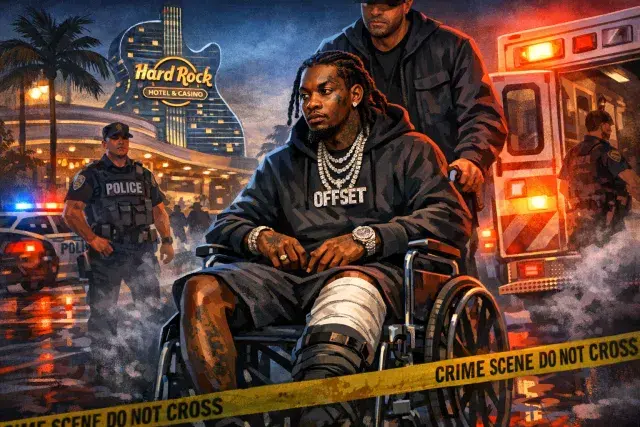
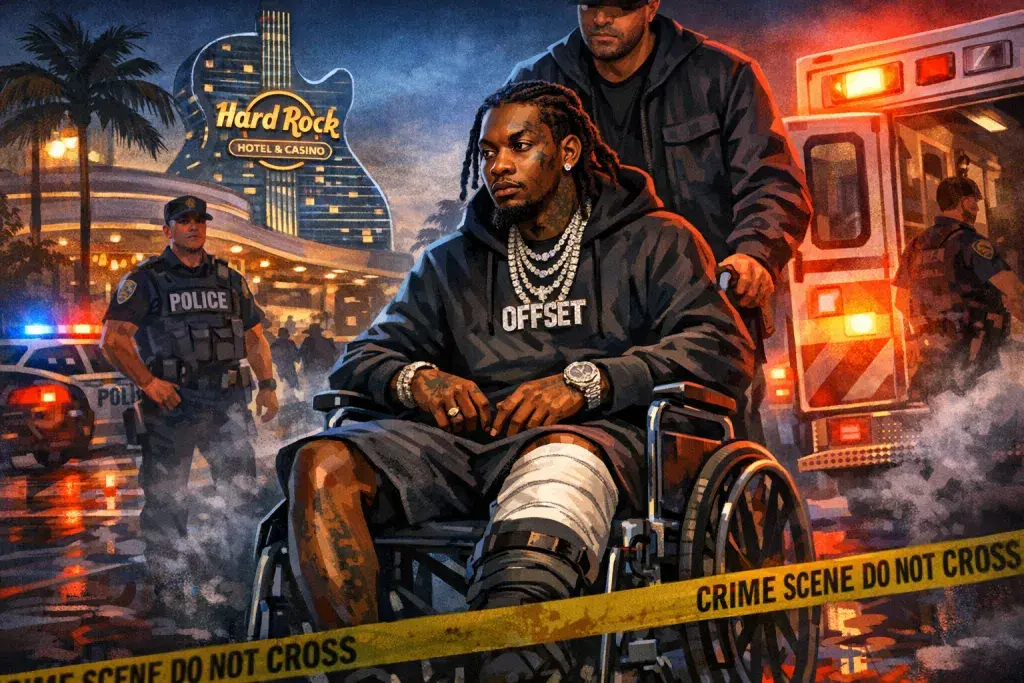
Rapper Offset has left hospital several days after sustaining a gunshot wound to his leg outside the Seminole Hard Rock Hotel & Casino in Hollywood, Florida — a venue as well-known for its celebrity draw as for the security challenges that come with high-profile gatherings. Authorities confirmed that the injuries were non-life-threatening, and the artist, whose legal name is Kiari Kendrell Cephus, was kept under observation before being cleared for discharge. The incident has renewed a familiar and uncomfortable debate about the safety of public figures in environments where large crowds, heightened energy, and limited controlled access converge.
What Happened Outside the Hard Rock
According to statements from police and Offset's representatives, the shooting occurred in the valet area of the Seminole Hard Rock Hotel & Casino — a transitional, semi-public space that sits at the boundary between a venue's internal security perimeter and the open street. An altercation preceded the gunfire, and responding officers detained two individuals as part of the ongoing investigation. Authorities were clear that no broader threat to the public existed, though the precise sequence of events and the identity of the shooter had not been officially confirmed at the time of writing.
Fellow rapper Lil Tjay was reported to have been arrested in connection with the altercation, though not for the shooting itself. His legal representatives have denied any involvement in the gunfire. The distinction matters: altercations in busy, high-profile public spaces frequently draw in bystanders and associates whose legal exposure varies considerably depending on what investigators ultimately establish.
Eyewitness accounts and images that circulated after the incident showed Offset in a wheelchair outside the hospital, visibly alert and interacting with those around him. His release signals a recovery that, while swift relative to what the circumstances might have produced, does not close the chapter on the legal and security questions the night left open.
A Career Marked by Both Prominence and Loss
Offset rose to international recognition as a founding member of Migos, the Atlanta-based trio whose rhythmic, interlocking vocal style — sometimes called "triplet flow" — reshaped the texture of mainstream hip-hop in the mid-2010s. Tracks such as Bad and Boujee and MotorSport placed the group at the center of a cultural moment that extended well beyond music into fashion, advertising, and broader popular culture. Offset has since developed a substantial solo career, sustaining his visibility independent of the group's collective output.
The Florida incident arrives less than three years after the death of Takeoff, another Migos member, who was fatally shot in Houston in November 2022. That killing, which occurred outside a bowling alley following a private event, was widely mourned within the hip-hop community and prompted serious discussion about the circumstances under which artists, their entourages, and their associates move through public spaces. Offset's survival of this latest incident — serious enough to require hospitalisation, but not fatal — does not diminish the pattern that such events collectively suggest.
Public Spaces, High-Profile Figures, and the Limits of Security
Casino environments present a particular security paradox. They are, by design, heavily surveilled and policed internally. Most large casino properties operate sophisticated monitoring systems, employ sizable private security forces, and maintain close relationships with local law enforcement. Yet the perimeter — the valet area, the entrance plaza, the drop-off zones — sits outside that controlled envelope. It is precisely in these transitional spaces that incidents tend to occur: visible enough to attract attention, open enough to present risk.
The broader question of artist safety in public settings has no simple answer. Touring musicians and public figures regularly move through environments — venue exits, hotel arrivals, restaurant appearances — where access cannot be fully controlled and where the concentration of attention they attract can itself become a liability. Security arrangements vary widely depending on the artist's resources, the nature of the event, and local law enforcement cooperation. There is no industry-wide standard, and the gap between a managed arena environment and an unstructured social occasion can be considerable.
Offset's recovery offers relief to his fans and to those who know him. It does not, however, resolve the circumstances that placed him in harm's way, nor does it address the structural conditions that continue to make such incidents a recurring feature of public life for artists at the highest levels of visibility.